
Maths Week England 2026
Maths Week England is Sunday 15th November to Saturday 21st November! From Monday to Friday, we’ll post problems at 9am, with solutions at 5pm. Email us any questions to problems-db@wesolveproblems.org.uk – we have a full database of problems at problems.org.uk.
The theme this year is Maths on the Move: all of these problems will involve movement in some way.
Problem 1 – Monday 16 November
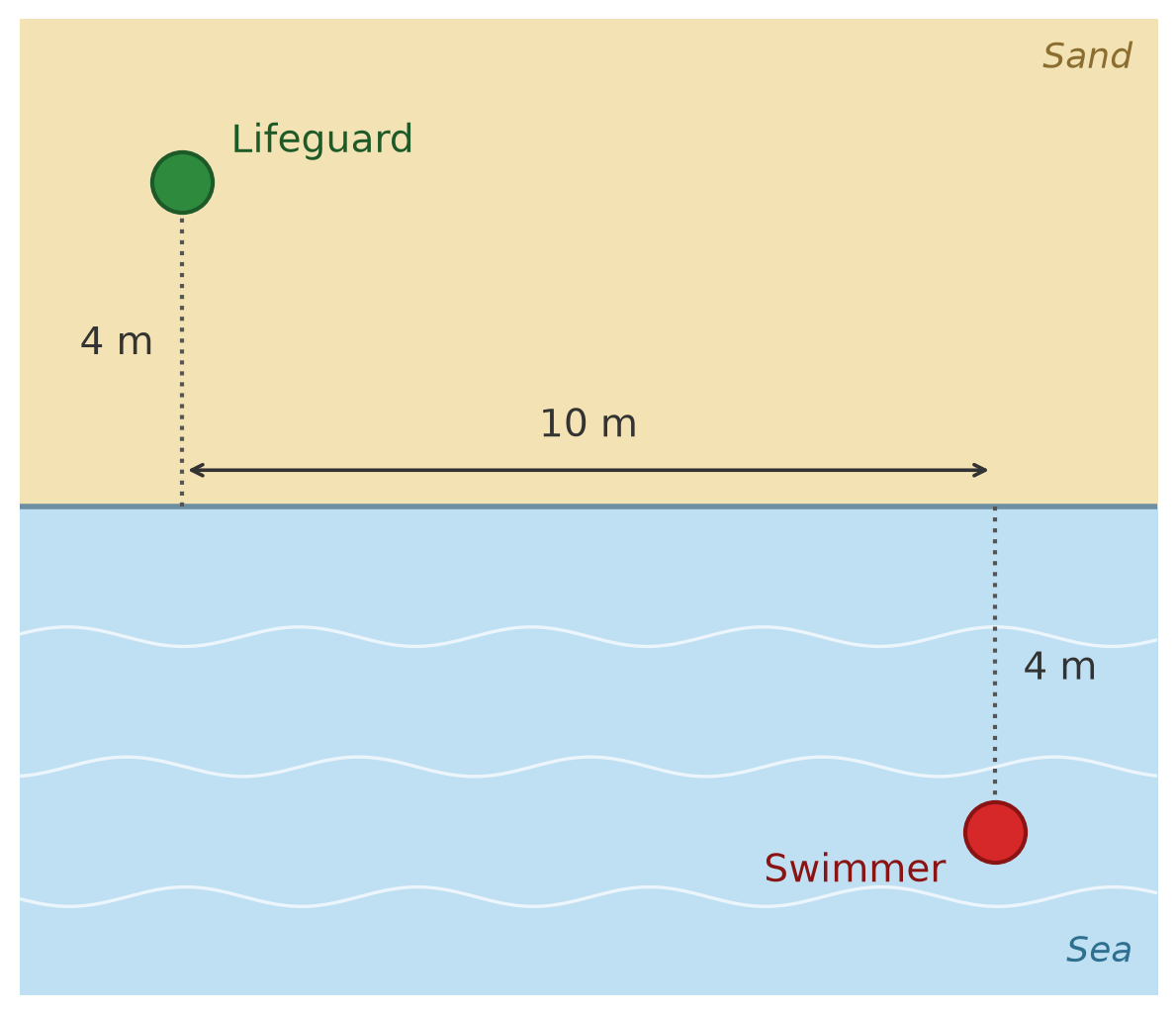
A lifeguard is standing on the sand, 4 m from the shoreline. A swimmer is struggling in the sea, 4 m from the shoreline. They aren’t directly opposite each other: the point on the shoreline nearest the lifeguard is 10 m from the point nearest the swimmer.
The lifeguard runs twice as fast as they swim. Where should they enter the water to reach the swimmer as quickly as possible?
Solution
Suppose the lifeguard enters the water x metres along the shoreline from the point nearest them, where 0 ≤ x ≤ 10. Let their swimming speed be v, so their running speed is 2v.
By Pythagoras, they run √(x² + 16) metres. They then swim the remaining 10 − x metres along, plus 4 m out, which is √((10 − x)² + 16) metres. So the total time is
T(x) = √(x² + 16)/(2v) + √((10 − x)² + 16)/v.
To minimise T, differentiate and set the result to zero:
T′(x) = x/(2v√(x² + 16)) − (10 − x)/(v√((10 − x)² + 16)) = 0,
which simplifies to
x/√(x² + 16) = 2(10 − x)/√((10 − x)² + 16).
Square both sides and clear the denominators. This gives
3x⁴ − 60x³ + 348x² − 1280x + 6400 = 0,
which factorises as (x − 8)(3x³ − 36x² + 60x − 800) = 0. The cubic factor has only one real root, at about x ≈ 12.2. That’s outside the range 0 ≤ x ≤ 10, and it only appeared because we squared. So x = 8 is the only stationary point.
It’s a minimum (exercise left to the reader): T is larger at both ends of the range than at x = 8. So the lifeguard should enter the water 8 m along the shoreline, 2 m before the point directly opposite the swimmer.
Problem 2 – Tuesday 17 November
In the middle of the Dark Forest in Wonderland there is a large square clearing, where a wolf is sitting right in the middle of the square, and four dogs are sitting at the four vertices of the square. The wolf can run inside the square with maximum speed v, while the dogs can run along the edges of the square with the speed 1.5v. It is known that the wolf kills a dog if they meet one to one, and two dogs kill the wolf if they overpower it together. Can the wolf escape from that square into the forest?
Solution
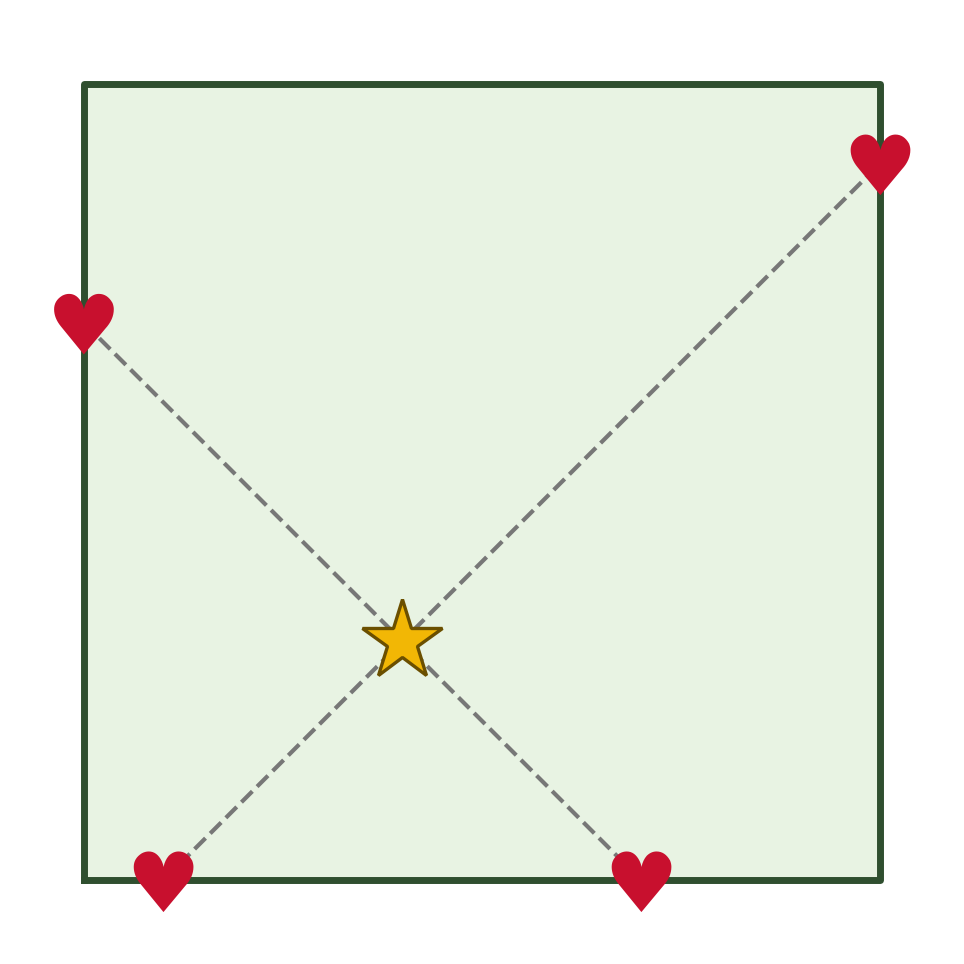
The idea is the following: draw lines parallel to the diagonals of the square through the wolf’s position at a certain time. The dogs should keep themselves at the points where these lines intersect the sides of the square. In the picture below, the star denotes the wolf and the hearts denote the dogs.
Can the dogs do this? If the wolf decides to move distance d in any diagonal direction, two dogs don’t move, but the other two have to move by a distance √2·d, because they move at an angle of 45° to the direction of the wolf and have to make up for that. If the wolf moves in any other direction, all four dogs move and each of them needs to therefore cover a smaller distance. Since 1.5 > √2, this strategy is possible for the dogs.
We can see that whenever the wolf approaches the boundary, two, or even sometimes three, dogs are already there, waiting for it. So it will always get caught.
Problem 3 – Wednesday 18 November
A bus, a truck, and a motorcycle move without acceleration and pass a stationary observer at equal time intervals in the order mentioned above. They pass another observer farther down the road at the same equal time intervals but in different order. This time the order is the bus, the motorcycle, and then the truck. The speed of the truck is 30 mph and the speed of the motorcycle is 60 mph – find the speed of the bus.
Solution
Denote by x (hours) the time the bus spent travelling between observers A and B, and by t (hours) the common time interval. From the formulation of the problem we deduce that the motorcycle spent x − t hours travelling between A and B, and the truck spent x + t hours. Now we can express the speeds of the motorcycle and the truck in terms of x and t:
1/(x − t) = 60 and 1/(x + t) = 30.
Solving this system of equations we obtain x = 1/40. Therefore, the speed of the bus is 1/(1/40) = 40 mph.
More on We Solve Problems
We Solve Problems runs Maths Circles and Maths Battles at universities across the UK – extracurricular programs for students in years 7-11.